
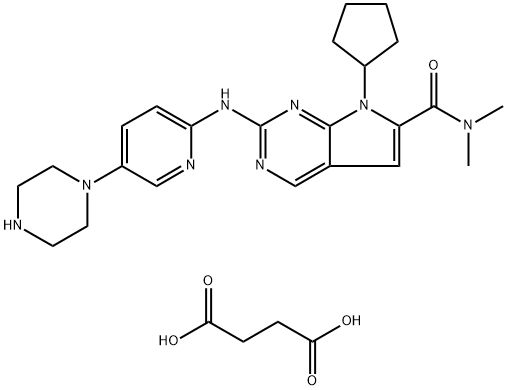
1374639-75-4
- Product Name:Ribociclib Succinate
- Molecular Formula:C27H36N8O5
- Purity:99%
- Molecular Weight:552.64
Product Details:
CasNo: 1374639-75-4
Molecular Formula: C27H36N8O5
Appearance: White to almost white Powder
Packing: Aluminium bag
Throughput: 100KG/Month
Purity: 99%
Brief Summary
Ribociclib succinate (CAS 1374639-76-2, LEE011) is an orally bioavailable, selective cyclin-dependent kinase CDK4/CDK6 inhibitor. It blocks cell-cycle progression in HR-positive, HER2-negative breast cancer by arresting cells at the G1 phase. Originally developed by Novartis under the brand name Kisqali®, it is widely used in combination with endocrine therapies for hormone receptor-positive advanced breast cancer. This API is supplied for generic formulation development, CMC documentation and preclinical oncology research.
Product Overview
Ribociclib succinate is the succinate salt form of ribociclib, a selective CDK4/6 inhibitor discovered by Novartis with the internal code LEE011. Dysregulation of CDK4 and CDK6 drives phosphorylation of retinoblastoma (Rb) protein, releasing tumour cells from G1-phase cell-cycle restriction and enabling uncontrolled proliferation. Compared with earlier CDK inhibitors, ribociclib demonstrates preferential potency toward CDK4 and CDK6, with limited off-target activity against other CDKs. The succinate salt is the crystalline form used in the commercial Kisqali® tablet formulation and serves as the reference standard for global generic development. It is a foundational agent for the endocrine combination regimen in HR+/HER2- advanced breast cancer.
Mechanism of Action
Cyclin D‑CDK4/6 complexes phosphorylate the Rb tumour suppressor protein, which releases E2F transcription factors and initiates the transition from G1 to S phase of the cell cycle. In HR-positive breast cancer, cyclin D-CDK4/6 signalling is frequently hyperactivated, sustaining tumour growth despite hormone deprivation. Ribociclib binds competitively to the ATP pocket of CDK4 and CDK6, suppressing Rb phosphorylation and locking tumour cells in G1 cell-cycle arrest. This antiproliferative effect synergises with endocrine therapies such as aromatase inhibitors or fulvestrant, amplifying growth suppression of HR-positive breast cancer cells without overlapping major toxicities.
Research & Clinical Background
Ribociclib received its first FDA approval in 2017, followed by approvals across the EU, China and other major markets. Key pivotal trials including MONALEESA‑2, MONALEESA‑3 and MONALEESA‑7 established its survival benefits. Core approved indications:
- In combination with an aromatase inhibitor as initial endocrine-based therapy for premenopausal, perimenopausal and postmenopausal adult patients with HR-positive, HER2-negative locally advanced or metastatic breast cancer;
- In combination with fulvestrant for HR-positive, HER2-negative advanced or metastatic breast cancer in adult patients with disease progression following prior endocrine therapy. Ongoing clinical programmes are investigating ribociclib in adjuvant and neoadjuvant breast cancer settings, as well as combination strategies with immunotherapy and targeted agents for other Rb-positive solid tumours.
Research & Commercial Applications
Our Ribociclib Succinate API is available for generic drug development and preclinical cancer research:
- Kisqali® generic formulation development, process scale‑up and complete CMC dossier preparation
- Crystal form characterisation, impurity profiling, analytical method validation and long-term stability testing
- In vitro CDK4/6 kinase assays, Rb phosphorylation detection and cell-cycle analysis
- In vivo xenograft and PDX tumour models of HR-positive breast cancer for efficacy evaluation
- SAR research for next-generation CDK4/6 inhibitors with improved selectivity and resistance coverage
- Combination pharmacology studies with endocrine agents, immune checkpoint inhibitors and other targeted therapies
Product Statement & Disclaimer
This product is Ribociclib Succinate API for pharmaceutical R&D and generic formulation. Batches manufactured under full GMP compliance can be used for clinical trial material production. It is not a finished medicinal product. End users must comply with local pharmaceutical regulatory requirements, complete quality audits and relevant registrations before clinical use. All technical data provided is for reference only.
Relevant Products
-
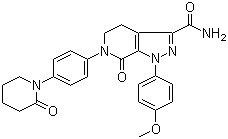 Apixaban
CAS:503612-47-3
-
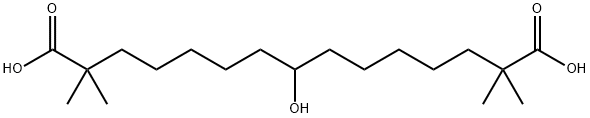 Bempedoic acid
CAS:738606-46-7
-
 2,3-Dimethyl-2-butene
CAS:563-79-1


